

Your customers expect the cloud, your product was built for the desktop
Your customers have relied on your software for years to run critical parts of their business. It installs at each site, keeps a database per customer and connects to the printers, scanners and devices their work depends on.
Now they expect to reach it from anywhere, and your cloud-based competitors don't ask them to run a server. That doesn't mean rebuilding everything as SaaS. We help you decide what to keep, what to change and how far to move.
One of the first AWS SaaS Competency partners worldwide

Validated by AWS
We have held the competency since AWS launched it in 2020. It is checked against real customer delivery, not a training course, and covers SaaS architecture, tenant isolation, onboarding, operations and the migration of existing products to SaaS.
The AWS SaaS playbook
We use the migration patterns, tenancy models and SaaS Lens reviews AWS has developed with thousands of software companies, so your product moves along a path AWS recognises and supports.
Built to be run
Since 2005 we have built and run platforms for SaaS companies, ISVs and regulated software teams, so the design accounts for how your product will be operated after launch, not only how it is built.
The hard part is rarely the database
Years of business logic often sit inside the forms themselves, which is why every change to a complex form takes longer than it should. Our team, with the assistance of AI, can now analyse a codebase of millions of lines in days. This is work that used to take engineers months.
Start with a five-day assessment
A fixed-price Rapid Modernisation Assessment before you commit to a larger analysis or build.
- Review your business case, code, tenancy, integrations and devices, security and identity, and hosting needs
- An options paper and a recommended direction
- Estimated effort, cost and time for each path together with risk profile.
- A walk through with your team of the findings
Three paths to SaaS
We review each SaaS path against your code, data, integrations and customers. The recommendation may be one path or a sequence that starts with one and grows into another.
Silo first
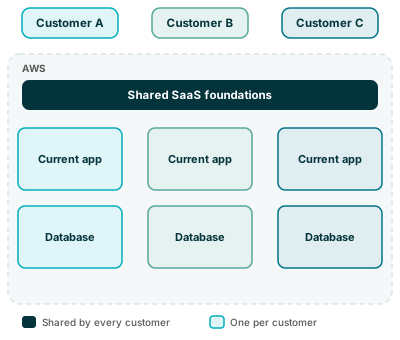
Each customer runs an isolated copy of your current application and database on AWS. It is the fastest route to SaaS with little change to the code, though running costs stay per customer.
Layered
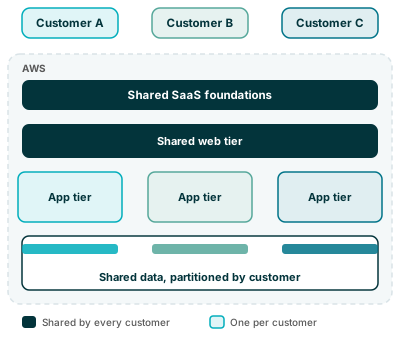
Layers move to multi-tenancy one at a time, usually the web tier and the data first, while each customer keeps its own application tier. You gain shared infrastructure, central data and simpler updates, in exchange for running two delivery models for a period.
Re-platform
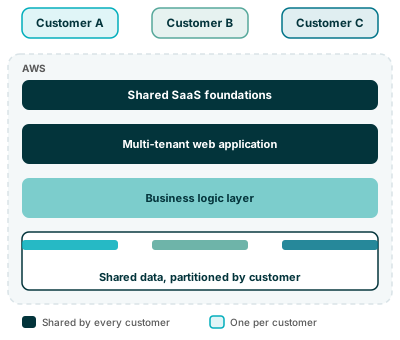
The product is rebuilt as one multi-tenant web application on a business logic layer extracted from the existing code. It is the largest investment of the three and the only path that retires the desktop product entirely.
Hosting alone is not SaaS
Every path includes the shared services that turn hosted software into a SaaS product.
- Tenant onboarding that provisions a new customer automatically
- One identity and sign-in model across every customer
- Tenant configuration held centrally instead of in each installation
- Metering of what each customer uses, ready for pricing and cost decisions
- Monitoring that shows the whole system and each customer within it
- One release pipeline that updates every customer
After the assessment
Plan the rebuild
The full Modernisation Assessment goes deeper into the code, data, integrations, security and operations, and gives you a staged roadmap with fixed-price work packages for the first stage. The rapid assessment fee is credited against it.
Rebuild on a running system
Where it fits, the current product moves onto AWS first so new customers start in the cloud straight away. The business rules are then pulled out of the screens and proven against the existing product before the new web application is built on them.
Run your product as a service
You receive documentation and a handover, or choose 24/7 managed operations through Cloud Management with agreed support responsibilities.
Audited and certified
AWS SaaS Competency
 ISO 27001
 AWS DevOps Competency